
Yesterday morning, my daughter didn't want to put on her swimsuit. Once we finally got her dressed and out the door, she was so upset that she yelled most of the way to school. By the time we got here, I had an elevated heart rate and a dull headache, and was ready to cry myself! Watching--and listening--to a child have an emotional melt down is nobody's favorite experience. As adults, it's our job to share our calm with our children through what is called co-regulation. For us, this looked like sitting together in the backseat of our car once we arrived, sharing a hug and taking some deep breaths before we walked in to school. We talked about how things can go better next time after we both felt less upset!
Co-regulation is a reciprocal process we can use as teachers and parents to help children calm their nervous systems in moments of distress. Through gentle and conscious co-regulation, we can teach kids how to self-regulate as they get older. Co-regulation is both a behavioral and biological process. When a caregiver and child engage in co-regulation, their nervous systems mimic each other in a phenomenon known as biological synchrony. Responsive caregivers pick up on emotional signals from the child and model ways to calm those emotions before teaching a new skill or enacting a consequence.
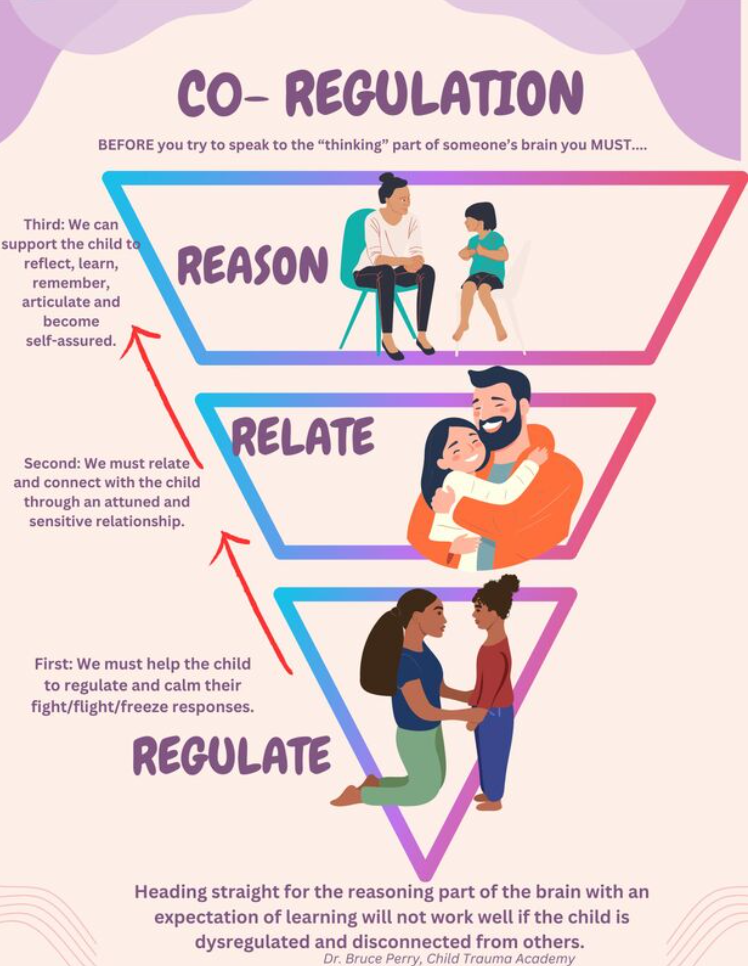
Below, find five simple steps to co-regulate with your child or children:
1. Make a safe space for co-regulating: At the ELS, this is often in the Cozy Corner/Cubby. Teachers set up soft pillows, and have fidgets, weighted lap blankets, and regulation technique visuals available for children to use as they sit with an adult (or sometimes, for older children, alone) to calm down. You can make something similar in your home, but use it only for supported regulation, rather than as a "time out" area; we work with teachers to ensure children only go to the Cozy Corner alone if they choose to do so, and never as a consequence for an undesired behavior, but rather as a place to take some space.
2. Help children label their feelings: Check out our feelings charts in each classroom, or the emotions books in the Parent Resource Library, to find great visuals for naming how we feel. Allowing children to tell us how they feel through their words, or even pointing to a picture, helps them conceptualize emotions as they get older.
3. Model naming emotions: Let your child know how you are feeling! "When you run away from me, I feel scared and angry." This lets your child know they can discuss their emotions with you without judgement or exclusion, and that they can be curious about their feelings rather than bottling them up. We all have feelings, even if we show them in vastly different ways.
4. Practice deep breathing and mindfulness techniques: Take belly breaths, practice a sensory walk (5 things you can see, 4 you can hear, 3 you can feel, 2 you can smell, 1 you can taste) or even watch a quick kids' mindfulness video together to pull focus away from the tantrum and towards regulating the body. Your child may participate with you, or they may just observe you--either is productive.
5. Give your child a hug or a squeeze if they want one: Connect and relate with your child to show them that no matter what they are feeling, you are there for them. Physical touch can be calming on the nervous system as well (think arm squeezes, wall pushes, or stomping feet), as it helps the brain release oxytocin.
What if you DO lose it? That's okay! It's important for our children to see that we are human too. If you lose your temper or yell, take a moment to calm down (self-regulate!) and come back to apologize when everyone is feeling better. Don't try to teach a new skill or have a long behavior conversation when either you or your child is upset; save those conversations for a calm moment and keep them short and to-the-point.
From one parent to another, I hope this helps in your most frustrating moments! We're all doing our best.
Add comment
Comments